
In January, I began an exciting journey of back-to-back interviews. Over just one month, I applied to 8 companies, and after more than 20 interviews, I received five job offers. All of these positions were fully remote, as I am located in Berlin, Germany. This was my second time taking on this challenge, and it's been a major boost to my career.
In this post, we'll talk about what I learned during this interview marathon and share some updates on the remote data market, focusing on devrel roles since that was my target.
You'll discover the reasons why embracing such a marathon could be a game-changer for your own software engineer/tech career and learn how to navigate this thrilling endeavor!
Let's start with the definition.
What is a Marathon?
As this is my second marathon, I think it would be nice to come up with some rules or definitions of what I consider a marathon of interviews.
Like any marathon, you prepare seriously for a race of endurance, mental strength, and physical fitness. The latter may not sound adequate in our case, but believe me, in this Zoom meetings era, sitting is the new smoking!
Note that for this marathon, my adventure was a little different because I was changing role, moving from a staff engineer to developer relations (devrel). The story behind this switch will be shared in another blog.
Preparation
Yourself
During this time, you review the skillset you lack for the target role so that you can either fill the gap during preparation or just be honest about your limit if you are hitting some wall during the interviews. It’s worth it to think about your answer if you are hitting such a wall. Is it because you haven’t practiced through a project for a while? Is it because you are lagging behind the new features? Are you willing to learn to fill the gap in that tech, or is this just not your target?
Think about which skillset you are strong for the role so that you can highlight them with concrete past examples.
To do so, you can write your brag document: which projects and impact you are the proudest of your career.
The company
You should spend some time researching which companies are interesting for you. Look online to understand their business and how healthy they are. Websites like Glassdoor and Crunchbase can give you some rough numbers. Then you can write down any questions you may have to ask the future interviewer. Don't forget that an interview involves both parties; it's also your responsibility to gather all the necessary information about the company, work culture, and technical setup.
List the top 10 companies you would like to work for.
Tip: it’s nice to ask the same questions to multiple interviewers to collect different data points.
Finally, update your LinkedIn profile, and define what projects and what impact you’ve done on your previous employer. You can also update a PDF-style CV as it is sometimes required. Having your website portfolio also helps to find everything, but again, you may need to update it.
Last, but not least, think about the realistic salary range to ask.
Applying
Don’t start applying directly to your top 3 favorite companies, do a mix to warm up these interview muscles!
Look at your LinkedIn network to see if anyone works at the company you are willing to apply.
Tip: On Linkedin, you can search based on company name and connection level
I would avoid cold reach to random people for a referral. But if you have an engineering manager in your 2nd connection hiring, it doesn't hurt to contact them directly AFTER you have applied to inform them that you are interested in a job role they published.
Interviews
Just follow the flow! Some processes are more painful than others, and you may see red flags that would discourage you from moving further. But as part of a marathon, that’s a whole goal to have time to try the good, the bad, and the ugly. There is always something to learn from a process, company, or interviewer.
One important thing to mention to the interviewer is your timeline and context. Giving information that you are on break to do a marathon of interviews and looking to start at a specific date would usually speed up the process. It means that your agenda is flexible, and you’ll be hired whatever happens in a few weeks, hopefully. There’s time pressure from both sides.
Weighing Options & Sealing the Deal
Congratulations! You’ve been through all the talks and tests, and now have some offers. It's time to negotiate based on your input.
A tip is that when starting the interview, just mention an expected salary range based on your research and the offer you received. There isn't any problem if you come back with a negotiation with a higher range than expected if you feel you were a bit under the market value. The most important is to justify why you are asking now for a higher salary. Stay humble, and polite and provide good arguments.
For this marathon, my requested salary range was lower than what I could get. After the first offers came out, I texted the companies that, based on these new data points, I’d like to update that salary range. It was pretty hard for me to evaluate what I'm worth as I was switching roles and mostly targeting US companies that have a different benchmark than the local Berlin tech scene.
Reaching out to people in your network who currently work at or have left the company is also a good idea. Don't be afraid to seek feedback. I've observed from experience that once a company has around 150 or more employees, numerous "micro-cultures" emerge, which means that one team may operate entirely differently from another.
Finally, I usually do a reverse interview with the future hiring manager once I have the offer to ask some additional questions.
Timeline
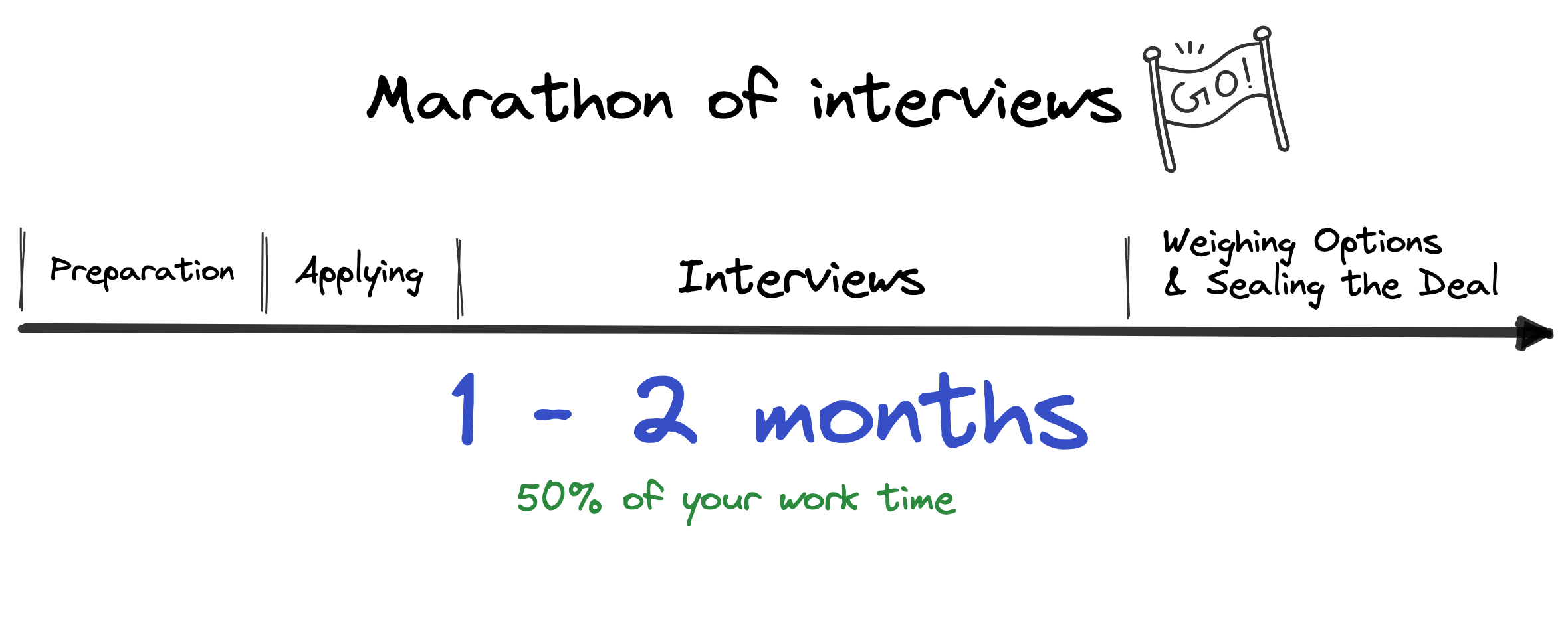
A couple of caveats :
Of course, the more senior you are, the easier it will be to get applications.
You may rush it into 1 month, but be aware that some processes can take longer for reasons that are out of your control (holidays, parental leave, etc.)
The 50% ratio highlights that I don’t believe you can work full-time while doing this marathon and not becoming insane. But you can do some work or relax with some other activities. Later one is my recommendation, as discussing with many people drains much energy.
Targeting companies out of the FAANG hype
Disclaimer: I've never worked at FAANG (or MANGA), but I did attend the final rounds at Meta a few years ago.
FAANG companies were on a hiring spree during the past decade of the flourishing tech industry. Now that times are getting harder and not going away soon, I believe any small company that didn't hire aggressively is in a great position to beat the competition. The reason is that they don't have to deal with a heavy layoff and all the consequences of it, which impact culture and motivation, to name a few.
That's the reason why I mostly applied to small companies that had decent runaway money in the bank. Though I couldn't predict some of them had their money at SVB that would crash… 🤦♂️
Anyway.
Smaller companies offer more flexibility and often have a smaller applicant pool, making them an ideal target. Unlike larger corporations with established remote entities, startups rely on services like Deel and Remote to hire remote people, providing you with the freedom to work from (almost) anywhere. If you are not familiar with these services, they are EOR (Employer of Record), and they basically act as an intermediate for contracts, payments, and everything else related to HR admin work. They have offices worldwide, and they will give you a local contract based on your location. No worries about taxes; it’s like you would have another job in your country.
There are many other reasons why you would or not consider startups over FAANG, but to recap, if you are looking for a flexible remote job with a decent salary, open your mind to other opportunities.

Refine Your Niche Skills
As you progress to senior-level engineering roles, it's important to sharpen your skills and knowledge in a particular field. This could be technical (e.g., internal of databases) or domain-driven (e.g., data/analytics), helping you stand out. In my case, I specialized in DevRel within data infrastructure, a niche within a niche.
As I'm switching roles, I'll adapt my niche skills. As a data engineer, I was comfortable on the platform side. Now that I'm moving from devrel, I intend to boost my video and teaching skills as key differentiator skills. Yes, you will see more crazy video edits on my YouTube channel soonish.
US vs. EU Salary
So, what about the money? Well, as I mentioned above, this was a big guess when I asked for a salary range because I was applying for US companies, and there are a couple of things you need to consider.
As most of you may know, the EU/US systems are completely different. To summarize quickly,
we, as Europeans, pay more taxes and have a smaller salary, but we have a lot of things covered with little to no extra cost. This includes health insurance, generous unemployment benefits & PTO, etc. Just to give you an example, in Germany, anyone that has a job can have health insurance for his/her whole family "for free,” as it's included in their salary taxes. It's also common to take 1 year of parental leave for the mother, as the government covers it. It's not your salary at 100%, but it's decent enough to have great family time.
I’m not getting here into a debate about what’s the best. You can definitely make more money in US, but that depend on your family situation and a bunch of other stuff.
Do your own research.
A fun fact is that my first viral LinkedIn post was about this very subject of US vs. EU salary. Have a look at the comments; they are… interesting.
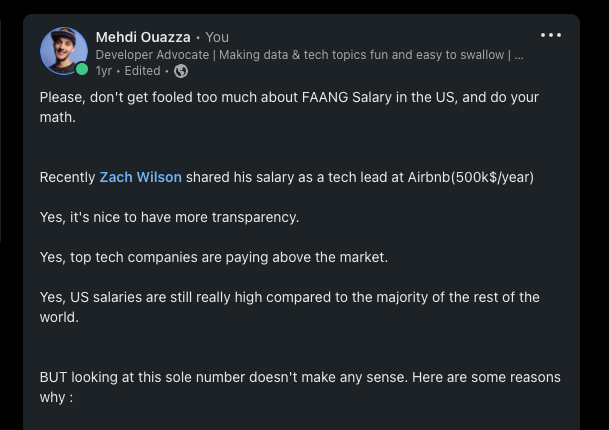
Next to that, it usually costs a bit more for US companies to hire in the EU (tax reasons), even if European are cheaper.
To sum up, if you apply to an US company, you can’t just ask for a 1:1 salary equivalent from the US. You need to take into account the above. You can assume that you will be on a “discount” compared to US level salary but above the national or even EU market (*).
If you want to know more about how different companies benchmark their salary, there’s the must-read classic from about this : The Trimodal Nature of Software Engineering Salaries in the Netherlands and Europe.
(*) excuding FAANG salaries
About DevRel $$
My strategy (and after hearing from other devrel experiences) was to benchmark myself against my software engineer experience because, after all, we are all software engineers.
I would add that you can probably add a multiplier depending on the variety of skills you have. For instance, can you do nice technical writing? Blog tutorial? Video hands-on? Can you edit videos? Do engaging thumbnails? In-person talks?
You may not need all of these as companies have different definitions and requirements on their devrel depending on the journey, but the fact that you may have some of these skills (to a certain level) in one person is more valuable than you think.
I defined myself as somehow a bit above seniority. But again, this doesn’t mean much. In practice in have 8 years of experience in data, and I’ve been doing content for the past two years in different forms. So, I'm not a complete newbie.
The offers I got were in the range of 160k-195k$ yearly base salary with equities between 20k-60k. TC (total comp) was, on average ~210k$ annually. PTO was always at least 20 days, the minimum legal in Germany.
If you look at US Silicon Valley salaries, that’s relatively “cheap” for a Senior Software Engineer. But if you look at Berlin, that’s above the tech market.
As a staff engineer, you can expect from ~120-150k$ yearly base salary from the Berlin tech scene.
Take a Break!
I can't stress enough to advise people to take a break whenever they want to change jobs or go through interviews. If you can't afford a month, take at least a week.
The power of running multiple interviews simultaneously and landing multiple offers will definitely be worth it, as you will have way more leverage for negotiation. Plus, having a free mind to measure the pros and cons of opportunities is key. After all, we spend a crazy amount of time working, so taking a week or a month is nothing compared to the time invested.
It's also a good time to just reflect on what you would like to do and do more interviews than needed just to test out what you like and what you don't like. Again, this is something you can't afford to do when working full-time. Plus, as time goes on, your motivation will go down. Having a timeboxed time to do your interviews will also push your effort to another level.
If you want to catch up on my first experience of such a marathon, applying as a data engineer, you can read about it here!
And may the interview force be with you.